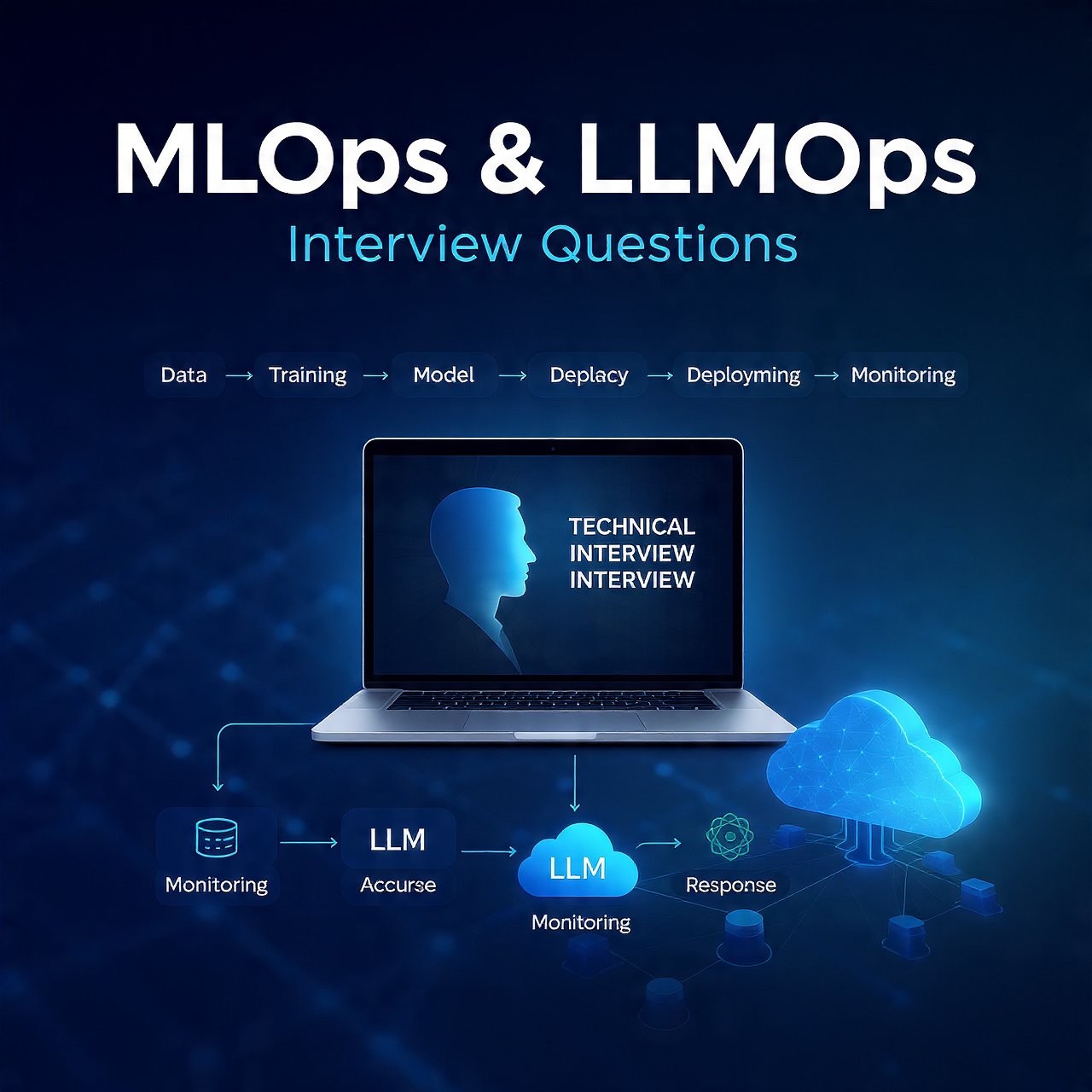
Description
- MLOps and LLMOps Comparison
Attribute MLOps LLMOps Primary focus End-to-end ML model lifecycle: data, training, CI/CD, serving Operationalizing large language models: prompt engineering, fine-tuning, RAG Primary users Data scientists, ML engineers, DevOps ML engineers, prompt engineers, platform teams Typical data Labeled datasets, features, model artifacts Massive text/code corpora, retrieval indices, user prompts Core components Data versioning; experiment tracking; model registry; CI/CD; monitoring Prompt/version control; fine-tuning; retrieval pipelines; cost & latency controls Advanced concerns Reproducibility, drift detection, governance, automated retraining Context window management, RAG orchestration, hallucination mitigation, cost optimization Description and Features from Basics to Advanced
- Definition — MLOps: MLOps is the discipline that applies DevOps principles to machine learning, enabling reproducible pipelines for data preparation, model training, testing, deployment, and monitoring.
- Definition — LLMOps: LLMOps is a specialized subset of MLOps focused on the operational challenges of large language models, including prompt engineering, fine-tuning, retrieval-augmented generation, and cost/latency management.
- Basic data practices: Both require data versioning, lineage, and validation to ensure training/serving parity; MLOps emphasizes labeled feature stores while LLMOps emphasizes curated corpora and retrieval indices.
- Experimentation and tracking: Core MLOps features include experiment tracking, hyperparameter management, and model registries to compare runs and promote artifacts to production.
- CI/CD for models: MLOps extends CI/CD with pipeline orchestration, reproducible environments (containers), automated tests for data and models, and gated deployments (canary/blue-green).
- Prompt and policy management: LLMOps adds prompt versioning, prompt templates, safety filters, and policy controls because small prompt changes can drastically alter outputs.
- Fine-tuning and adapters: Advanced LLMOps supports parameter-efficient fine-tuning (LoRA, adapters), instruction tuning, and continual fine-tuning pipelines to adapt foundation models to tasks.
- Retrieval Augmented Generation: LLMOps commonly integrates RAG pipelines—indexing, vector stores, retrieval strategies, and context assembly—to ground LLM outputs in external knowledge.
- Monitoring and observability: Production monitoring covers prediction quality, latency, resource usage, data drift, hallucination rates, and user-feedback loops; LLMOps also tracks prompt effectiveness and retrieval hit rates.
- Bias, safety, and explainability: Mature pipelines include bias testing, content-safety filters, explainability tools, and audit trails for compliance and trust.
- Cost and performance optimization: LLMOps must manage token costs, batching, model selection (distillation/quantization), and latency SLAs to make LLMs economically viable at scale.
- Automation and closed loops: Advanced systems implement closed-loop automation where monitoring signals trigger retraining, prompt updates, or fallback strategies without manual intervention.
- Security and access controls: Both require secure model registries, encrypted data stores, role-based access, and secrets management for safe production use.
- Testing strategies: Beyond unit tests, MLOps uses data tests, model-slice tests, and shadow deployments; LLMOps adds scenario-based prompt tests, adversarial prompt testing, and hallucination benchmarks.
- Scalability patterns: MLOps scales via distributed training, feature-store sharding, and autoscaling serving infra; LLMOps adds model sharding, offloading, and hybrid on-prem/cloud inference for very large models.
- Governance and lineage: Advanced governance enforces model provenance, dataset lineage, approval workflows, and regulatory reporting for audits.
- Tooling ecosystem: Typical MLOps tools include Kubeflow, MLflow, TFX, Seldon; LLMOps layers on vector stores, RAG orchestrators, prompt stores, and cost/usage dashboards.
- Adoption path: Start with reproducible pipelines, telemetry, and basic CI/CD, then add monitoring, governance, and automated retraining for MLOps; for LLMOps, begin with prompt/version control and RAG, then add fine-tuning, safety, and cost controls.