Description
Data Engineering with Dataiku — Overview for 3–20 Years Experience
- Role summary: Data engineering in Dataiku focuses on building, orchestrating, and operationalizing reliable data pipelines for analytics and ML.
- Platform scope: Dataiku is an end‑to‑end data platform that combines visual tooling, code notebooks, and production deployment features.
- Ingest and connectors: It provides broad connectors and dataset types to ingest from databases, cloud storage, streaming sources, and enterprise systems.
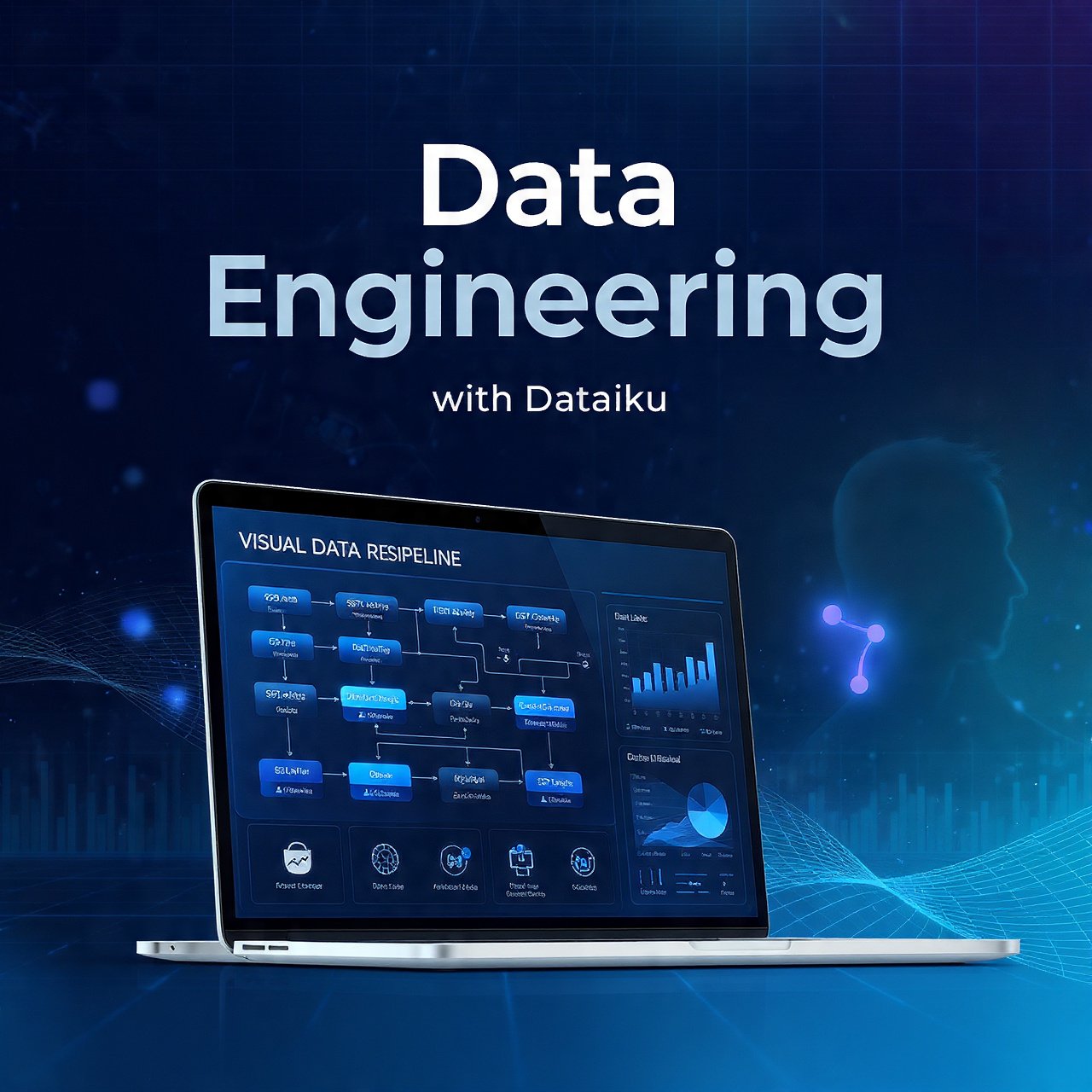
- Visual recipes: Non‑coding users can use visual recipes for joins, pivots, aggregations, and cleansing while engineers can inspect generated SQL.
- Code-first options: Data engineers can write Python, SQL, and R code, use notebooks, and integrate libraries for custom transformations and testing.
- Scalable compute: The platform integrates with Spark, Dask, Databricks, Snowpark, and other engines so pipelines scale from single nodes to distributed clusters.
- Feature engineering: Built‑in feature generation, transformation recipes, and feature stores accelerate ML‑ready dataset creation.
- Data quality: Automated profiling, schema checks, and data quality rules help detect drift and enforce contracts across environments.
- Orchestration: Scenarios and flow scheduling enable dependency‑aware orchestration, retries, and alerting for production jobs.
- Testing and CI/CD: Support for unit tests, versioning, Git integration, and deployment pipelines helps maintain reliability at scale.
- Governance: Role‑based access, lineage visualization, and audit trails provide traceability for compliance and collaboration.
- Performance tuning: Engineers can push down SQL, tune partitioning, and choose execution backends to optimize throughput and cost.
- Operational monitoring: Built‑in metrics, logs, and model monitoring allow teams to track pipeline health and model performance in production.
- Advanced integrations: Dataiku supports custom plugins, APIs, and orchestration hooks to embed into enterprise ecosystems and MLOps stacks.
- Skill expectations ( ): Deliver reliable ETL/ELT pipelines, implement transformations in code and visual recipes, and manage connectors.
- Skill expectations ( ): Architect scalable data platforms, design governance and CI/CD for pipelines, optimize distributed compute, and lead cross‑functional MLOps.
Quick takeaway: For mid to senior candidates, emphasize both hands‑on pipeline implementation (visual + code) and higher‑level architecture, scalability, governance, and operationalization skills when working with Dataiku.