Description
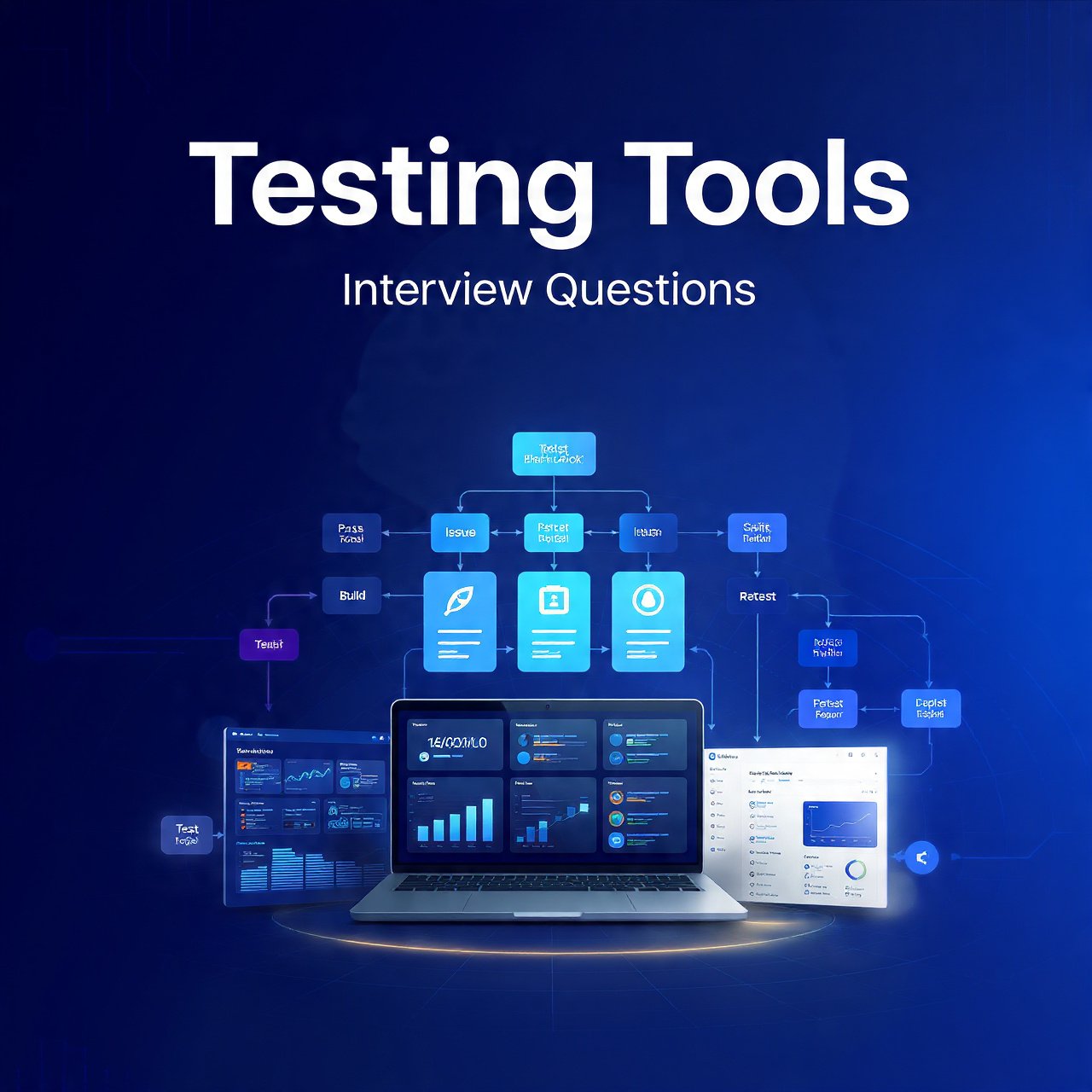
- Testing Tools — basic to advanced features
- Selenium — Browser automation for functional UI tests; supports WebDriver, cross‑browser grids, and language bindings.
- Cypress — Fast end‑to‑end testing for modern web apps with time‑travel debugging and automatic waits.
- Playwright — Multi‑browser automation with built‑in network interception, parallelism, and test isolation.
- JUnit — Unit testing framework for Java with annotations, parameterized tests, and lifecycle hooks.
- TestNG — Advanced test orchestration for Java: parallel execution, dependency management, and data providers.
- PyTest — Python testing with fixtures, plugins, parametrization, and rich assertion introspection.
- Cucumber — BDD framework enabling Gherkin feature files, living documentation, and stakeholder‑readable scenarios.
- Appium — Mobile automation for native/hybrid apps across iOS and Android with device farm integration.
- Postman — API development and testing with collections, environments, automated monitors, and contract checks.
- SoapUI — Functional and security testing for SOAP/REST APIs with assertions and mock services.
- JMeter — Load and performance testing for web and API endpoints with distributed execution and reporting.
- Gatling — Code‑centric performance testing with high throughput, scenario DSL, and detailed metrics.
- Locust — Python‑based load testing with programmable user behavior and real‑time web UI.
- SonarQube — Static code analysis for quality gates, security hotspots, and technical debt tracking.
- Pact — Consumer‑driven contract testing for microservices with pact broker and verification pipelines.
- Allure — Test reporting and visualization with rich attachments, history, and trend analysis.
- Jenkins — CI/CD orchestration for test automation pipelines, parallel stages, and artifact promotion.
- TestRail — Test management for cases, runs, traceability to requirements, and release reporting.
- Junior — Focus on test automation fundamentals, reliable locators, CI integration, flaky test mitigation, and basic performance checks.
- Mid — Add test architecture, parallel execution, service virtualization, contract testing, observability, and test data strategies.
- Senior/Lead — Drive test strategy, platform‑level test frameworks, cost‑efficient distributed load testing, governance, and cross‑team quality metrics.