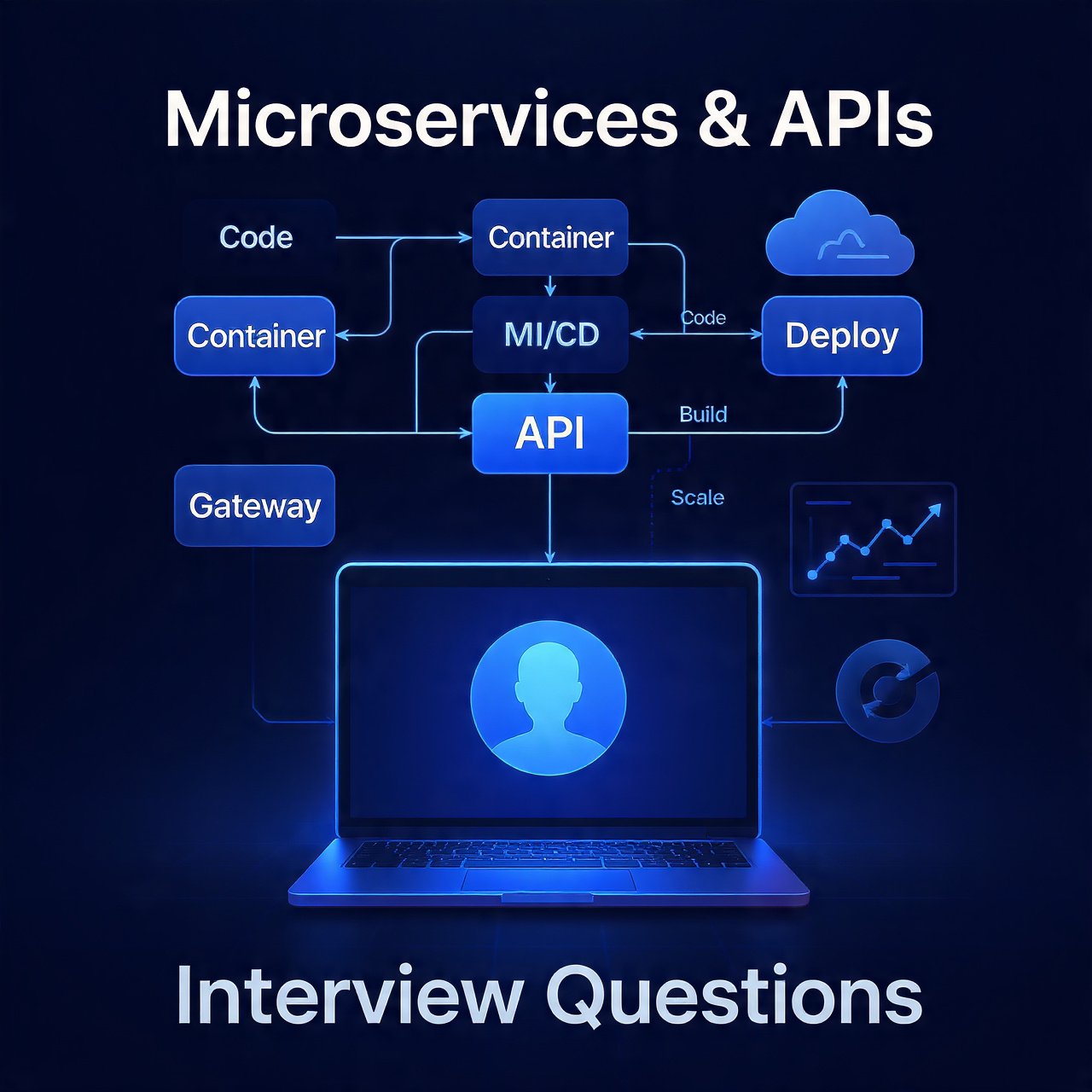
Description
Microservices APIs Cloud Native DevOps
- Microservices Definition: Small, autonomous services that implement single business capabilities and are independently deployable.
- API Role: APIs are the primary contracts between services and external clients; design for versioning, idempotency, and clear SLAs.
- Service Boundaries: Use bounded contexts and domain‑driven design to define service scope and minimize coupling.
- Communication Patterns: Synchronous REST/gRPC for request/response; asynchronous messaging, event streams, and pub/sub for resilience and scalability.
- Data Management: Prefer database per service, event sourcing, and CQRS where needed to avoid shared‑schema coupling.
- Cloud Native Principles: Design for immutable infrastructure, disposability, horizontal scaling, and platform automation.
- Containerization and Orchestration: Use containers and Kubernetes for scheduling, service discovery, autoscaling, and self‑healing.
- Observability: Implement distributed tracing, structured logging, and metrics to correlate user impact with service health.
- Security: Apply zero trust, mTLS between services, API gateways, rate limiting, and centralized secrets management.
- Resilience Patterns: Circuit breakers, bulkheads, retries with backoff, and graceful degradation to maintain availability.
- CI/CD and GitOps: Automate build, test, and deployment pipelines; use GitOps for declarative environment promotion and rollbacks.
- Testing Strategy: Unit tests, contract tests for APIs, component tests, and production‑like end‑to‑end tests with canary or blue/green deployments.
- Performance and Cost: Profile latency, optimize cold starts, right‑size compute, and use autoscaling policies tied to business metrics.
- Platform Engineering: Build internal developer platforms, self‑service pipelines, and reusable service templates to accelerate teams.
- Governance and Compliance: Enforce API standards, RBAC, audit trails, and data residency controls across environments.
- Advanced Patterns: Service mesh for observability and policy, API composition, and backend for frontend (BFF) for client‑specific APIs.
- Operational Excellence: Runbooks, SLOs/SLA definitions, error budgets, and postmortems that drive continuous improvement.
- Leadership Expectations: For 3–20 years experience, demonstrate end‑to‑end architecture decisions, tradeoffs between monolith vs microservices, incident remediation you led, and measurable business outcomes from platform or process changes.