Description
LangChain LangGraph RAG Vector Databases Fine Tuning
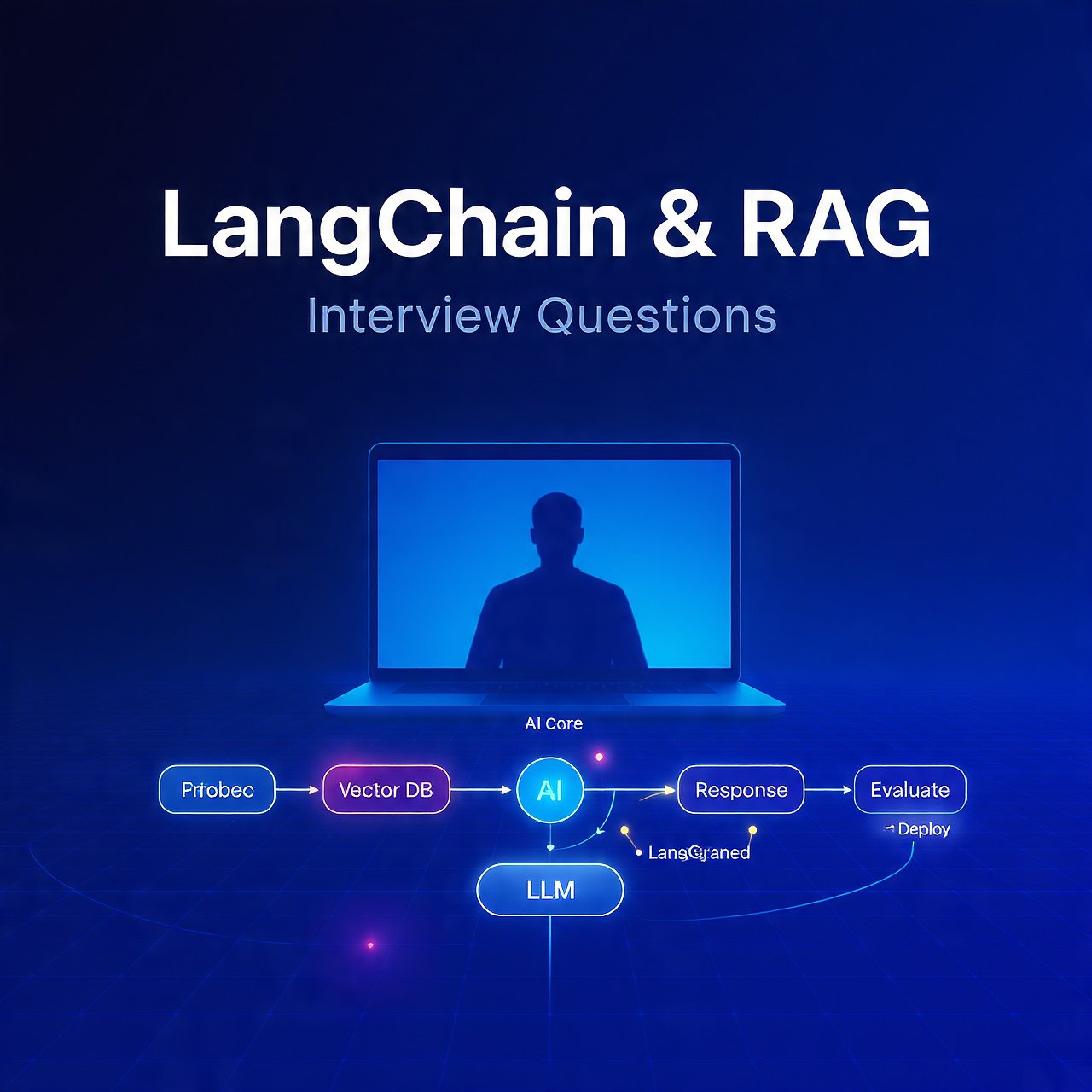
- Overview: Retrieval‑Augmented Generation (RAG) combines large language models with document retrieval to produce contextually accurate responses.
- LangChain purpose: LangChain provides building blocks to load, split, embed, and orchestrate documents and LLM calls for RAG pipelines.
- LangGraph purpose: LangGraph models stateful, modular workflows and controls the order of retrieval and generation steps for complex agents.
- Vector database role: Vector DBs store embeddings for semantic search, enable fast nearest‑neighbor retrieval, and scale with sharding and ANN indexes.
- Embeddings: Create dense vector representations of text using model embeddings to enable semantic similarity and chunked context retrieval.
- Chunking and indexing: Document chunking, metadata tagging, and index tuning determine recall, latency, and prompt window utilization.
- Retriever strategies: Use hybrid retrieval, semantic + lexical reranking, and multi‑stage retrieval to balance precision and recall.
- Prompting and context assembly: Build dynamic context windows, use relevance scoring, and apply prompt templates or chains to guide generation.
- LLM orchestration: Manage model selection, temperature, token limits, and batching for throughput and cost control.
- Fine‑tuning vs adapters: Fine‑tuning customizes model behavior on domain data; lightweight adapters or instruction tuning can be lower cost and faster to iterate.
- Evaluation and metrics: Measure factuality, relevance, hallucination rates, and retrieval precision; use human‑in‑the‑loop labeling for edge cases.
- Safety and governance: Enforce content filters, provenance tracking, and access controls; log retrieval sources for auditability.
- Operationalization: CI for data pipelines, automated reindexing, vector DB backups, and canary deployments for model updates.
- Performance tuning: Optimize embedding model choice, index parameters, and caching to reduce latency and cost.
- Advanced patterns: Multi‑vector stores, cross‑document reasoning, tool use via agents, and stateful conversational graphs for long dialogues.
- Experience progression: 3–5 years focus on building RAG prototypes and integrating vector stores; 6–12 years on productionizing pipelines, tuning retrieval, and model ops; 13–20 years on platform design, governance, and enterprise‑grade ML lifecycle automation.