Description
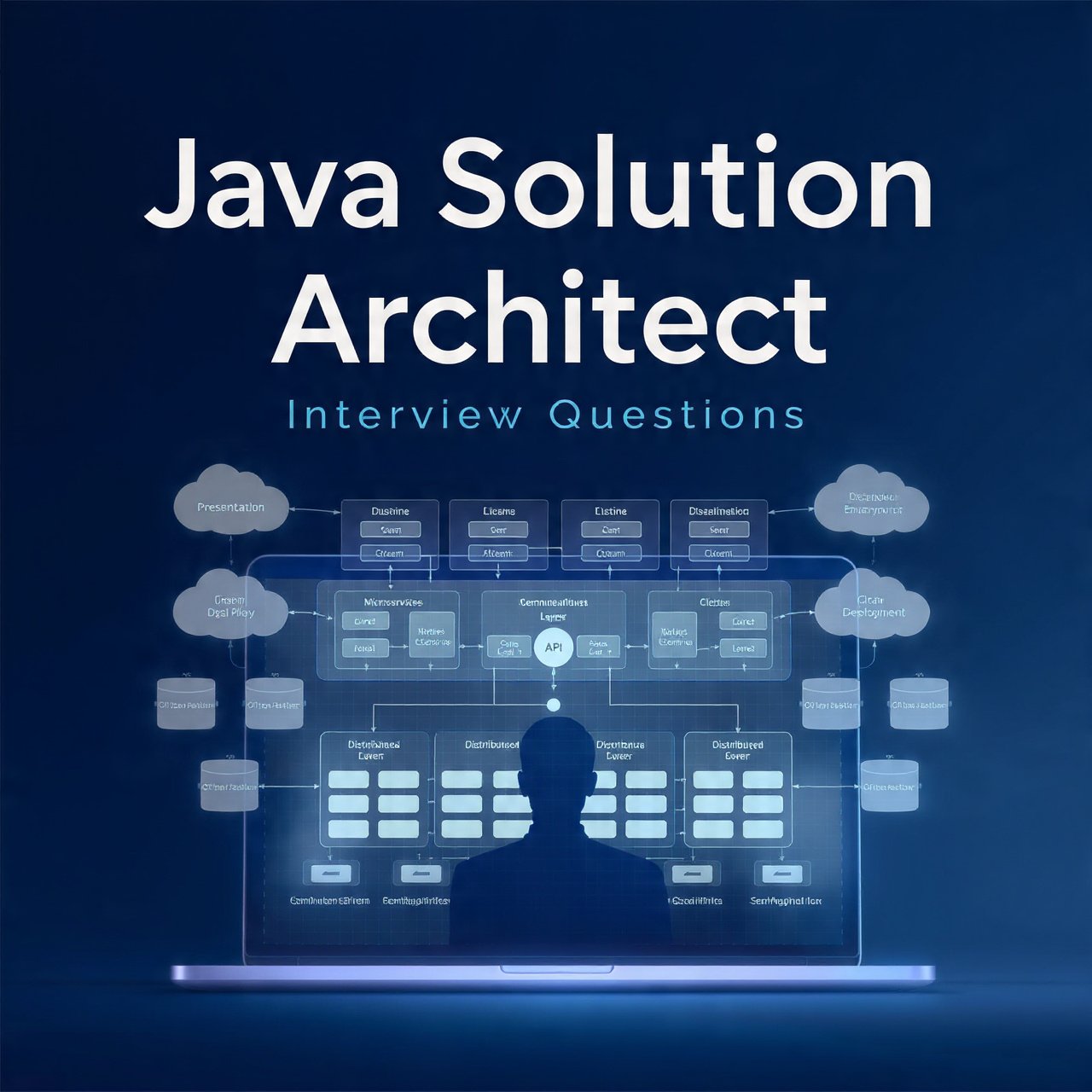
Java Solution Architect
- Role overview: Designs end‑to‑end Java‑based solutions that align technical choices with business goals and nonfunctional requirements.
- Core language expertise: Deep mastery of Java SE/EE, JVM internals, performance tuning, and modern Java features.
- Frameworks and libraries: Expert in Spring Boot, Spring Cloud, reactive stacks, and common middleware for building resilient services.
- Architectural patterns: Designs microservices, modular monoliths, event‑driven systems, and domain‑driven architectures with clear bounded contexts.
- API strategy: Defines REST/GraphQL contracts, versioning, contract testing, and API gateway patterns for secure, evolvable interfaces.
- Data strategy: Chooses between relational and NoSQL stores, models transactions and consistency, and optimizes queries and indexing.
- Integration and messaging: Selects and patterns for synchronous and asynchronous integration using queues, streams, and CDC approaches.
- Cloud and platform design: Architects for AWS/Azure/GCP managed services, container platforms, and platform‑as‑a‑service tradeoffs.
- DevOps and delivery: Specifies CI/CD pipelines, immutable deployments, blue/green and canary release strategies, and infrastructure as code integration.
- Security and compliance: Embeds authentication/authorization (OAuth2, JWT), secrets management, threat modeling, and regulatory controls into designs.
- Observability and operations: Defines logging, distributed tracing, metrics, and SLO/SLI‑based alerting for production readiness.
- Performance and scalability: Leads capacity planning, caching strategies, backpressure, circuit breakers, and JVM/Garbage Collector tuning.
- Testing and quality gates: Establishes unit, integration, contract, chaos, and performance testing as part of gated pipelines.
- Governance and standards: Creates reusable reference architectures, coding standards, and platform libraries to enforce consistency at scale.
- Migration and modernization: Plans brownfield migrations, strangler patterns, and incremental refactors to reduce risk and technical debt.
- Leadership and stakeholder management: Translates business requirements into technical roadmaps, mentors engineers, and drives cross‑team alignment.
- Experience progression: 3–5 years focus on design patterns and service ownership; 6–12 years on cross‑service architecture and platform building; 13–20 years on enterprise strategy, governance, and technical leadership.