Description
Informatica MDM Developer Skills and Features
- Role summary: Builds and maintains master data solutions to create a single trusted view of critical entities (customers, products, suppliers).
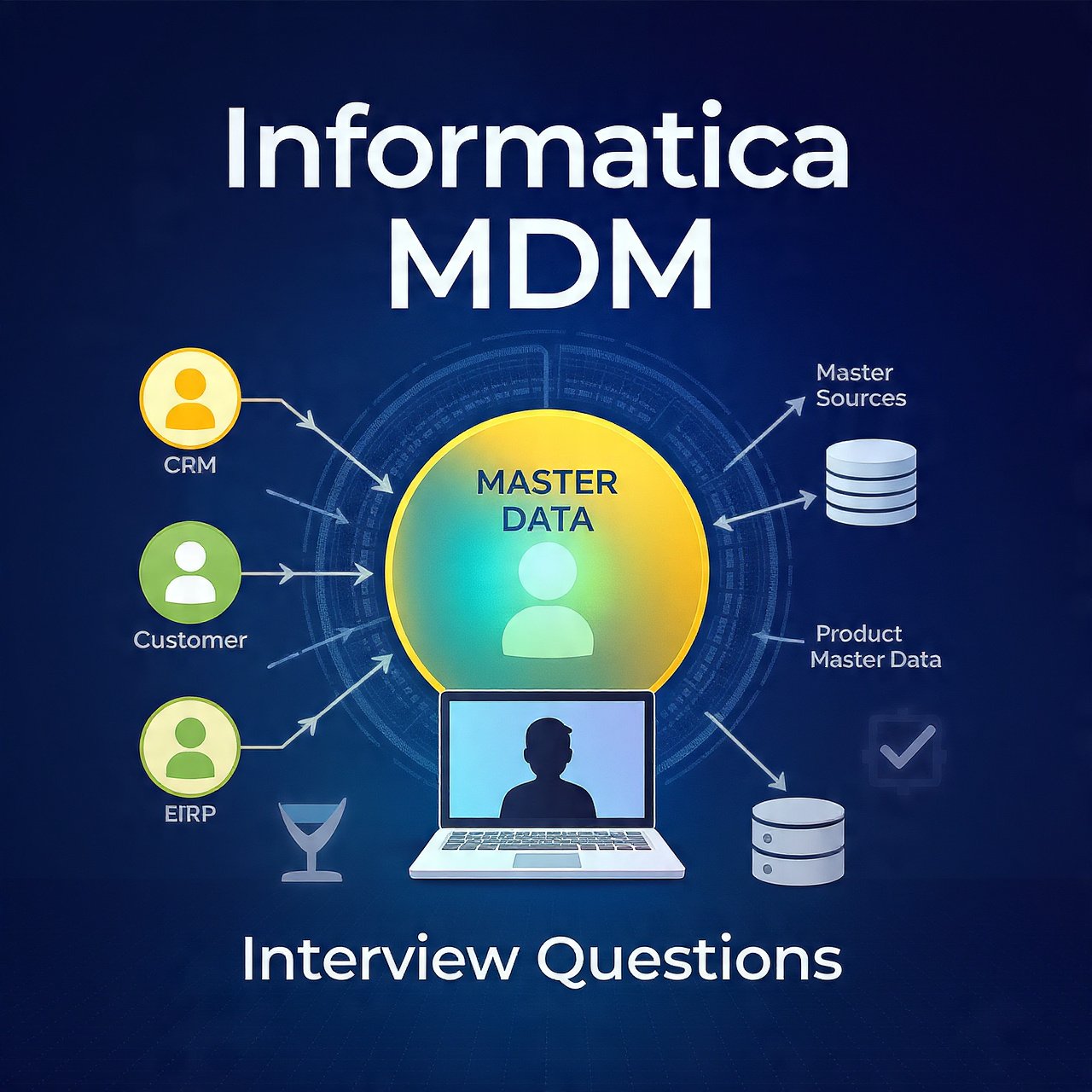
- Core concept: Implements Master Data Management principles—data consolidation, cleansing, matching, and survivorship to produce the golden record.
- Multidomain support: Works across domains (customer, product, supplier, location, employee) within a single MDM hub.
- MDM architecture: Designs and configures Hub, Match, Merge, Survivorship, and Staging layers; maps source-to-hub data flows.
- Integration skills: Integrates MDM with ETL/ELT pipelines, Informatica PowerCenter/IDMC, APIs, and messaging for real-time and batch ingestion.
- Data quality: Implements profiling, standardization, validation rules, and address cleansing to improve source data before matching.
- Matching and survivorship: Tunes match rules, thresholds, and survivorship logic to balance precision and recall for different domains.
- Hierarchy and relationship management: Models hierarchies, relationships, and hierarchal survivorship for complex product and organizational structures.
- Workflow and stewardship: Builds approval workflows, stewardship consoles, and business user UIs for manual review and exception handling.
- Security and compliance: Implements role-based access, data masking, audit trails, and GDPR/PDPA controls for sensitive master data.
- Performance and scalability: Designs partitioning, indexing, and batch strategies; optimizes match engine and hub performance for large volumes.
- Cloud and SaaS deployment: Migrates or implements Informatica Multidomain MDM on-premises or as MDM SaaS/IDMC with hybrid architectures.
- APIs and microservices: Exposes and consumes REST/JSON services for CRUD, search, and enrichment; supports event-driven integrations.
- Advanced capabilities: Implements survivorship rules by business context, golden record enrichment, machine learning-assisted matching, and reference data management.
- Monitoring and observability: Sets up logging, metrics, SLAs, and automated alerts for data pipelines and match jobs.
- Testing and deployment: Creates unit/integration tests, CI/CD pipelines, rollback plans, and migration scripts for safe releases.
- Career progression: Junior to mid (3–7 years) focuses on configuration, mappings, and data quality; senior to architect (8–20 years) leads design, governance, cloud migration, and cross-domain strategy.