Description
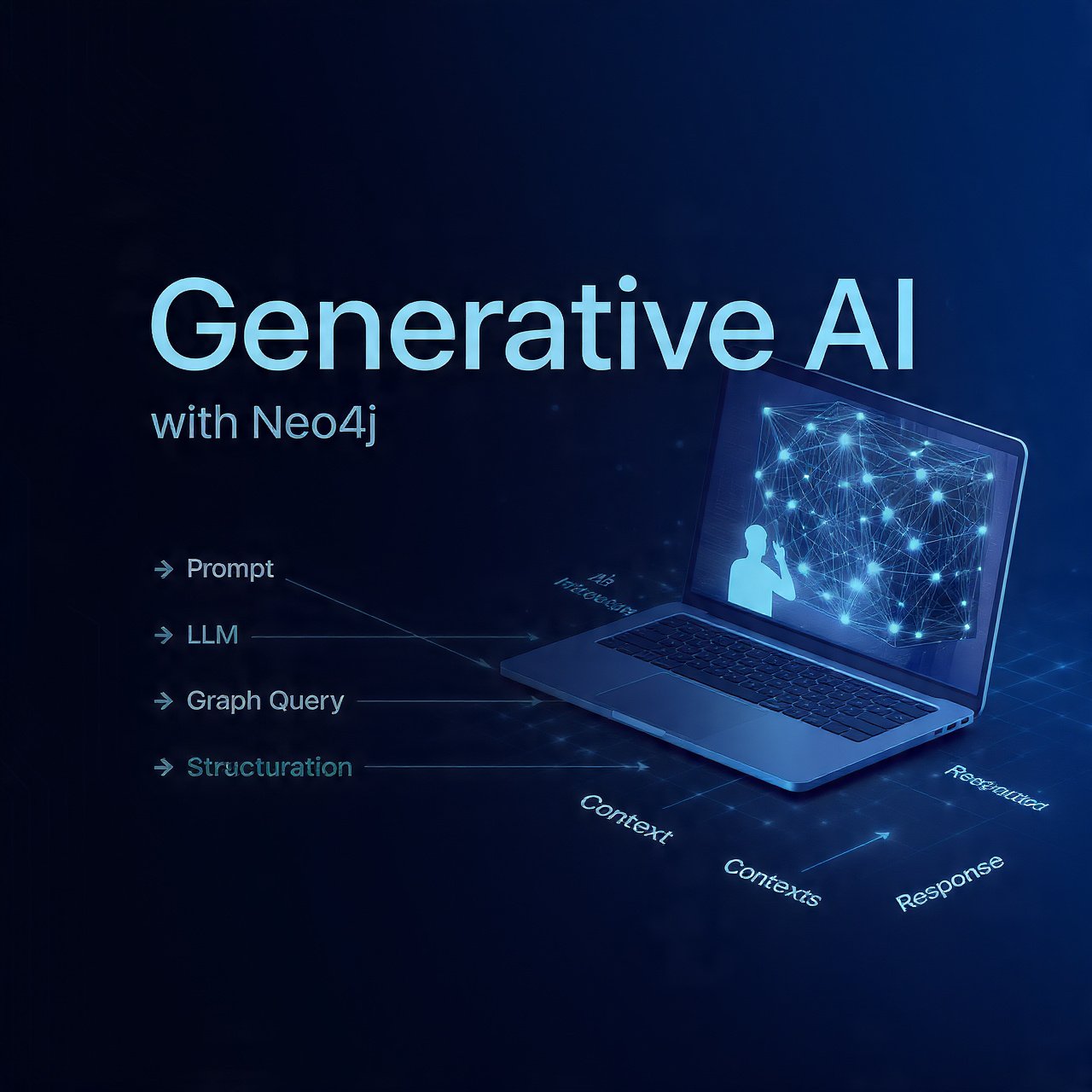
Generative AI with Neo4j Overview
- Purpose: Combine generative models with graph databases to ground LLM outputs in structured organizational knowledge.
- Knowledge Graph Grounding: Use Neo4j to store facts, relationships, and provenance so responses reference verifiable nodes and edges.
- GraphRAG Pattern: Implement Graph‑augmented Retrieval (GraphRAG) to retrieve context via graph traversal before generation.
- Vector Search and Embeddings: Index text embeddings alongside graph entities for semantic lookup and nearest‑neighbor retrieval.
- Context Enrichment: Enrich LLM prompts with multi‑hop graph context to improve factuality and reduce hallucinations.
- Explainability: Trace generated answers back to graph paths and source nodes to provide transparent provenance.
- Schema Modeling: Design entity and relationship schemas that reflect domain ontologies for precise retrieval and reasoning.
- Cypher Integration: Use Cypher queries to extract subgraphs, compute features, and feed structured context into prompts.
- Graph Data Science: Leverage centrality, similarity, and community detection to surface high‑value context and candidate facts.
- Hybrid Retrieval: Combine keyword, vector, and graph‑topology signals to rank evidence for generation.
- Fine‑tuning and Adaptation: Use graph‑filtered corpora and domain examples to fine‑tune models for domain accuracy.
- Agent Orchestration: Integrate Neo4j with multi‑agent frameworks and cloud GenAI services to coordinate tool use and memory.
- Safety and Governance: Enforce policy checks by tagging sensitive nodes, auditing retrievals, and logging provenance for compliance.
- Performance Engineering: Benchmark latency for graph traversals, vector lookups, and model inference; optimize caching and sharding.
- Monitoring and Drift Detection: Instrument production to detect concept drift, stale facts, and retrieval failures tied to graph changes.
- Security Testing: Test for prompt injection, data exfiltration via graph queries, and access control on sensitive subgraphs.
- Productionization: Automate pipelines for graph ingestion, embedding refresh, CI for prompt/regression tests, and explainable response delivery.