Description
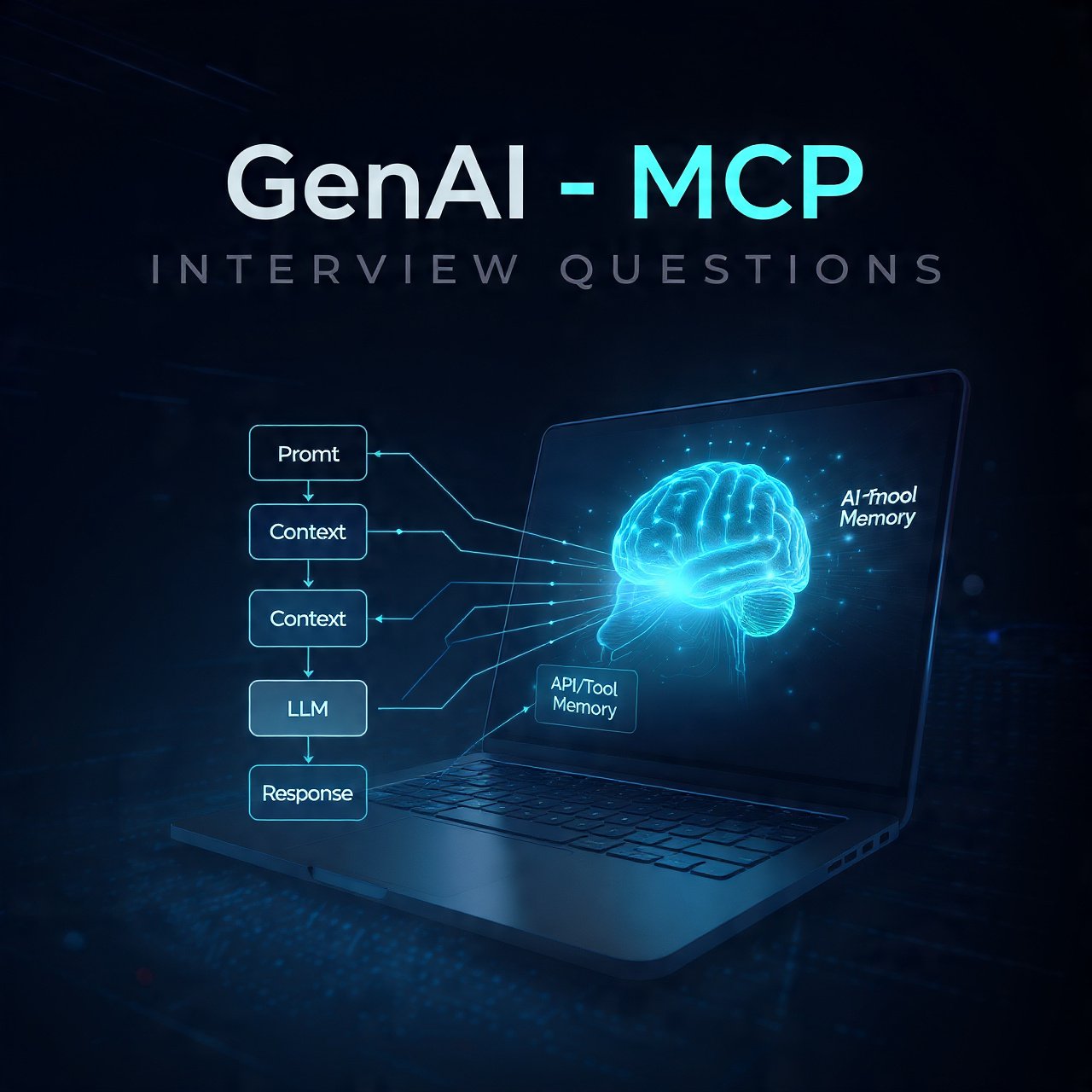
Generative AI with Model Context Protocol
- Model Context Protocol (MCP) is an open standard that standardizes how AI models connect to external tools, data sources, and workflows.
- Purpose: MCP acts like a universal connector so LLMs and agents can read files, call APIs, and access databases without bespoke integrations.
- Core capability: it defines a common schema and runtime for exchanging contextual data, function calls, and tool manifests between models and services.
- Developer ergonomics: MCP provides SDKs and server implementations that let engineers expose services to agents with minimal glue code.
- Agent enablement: by exposing capabilities via MCP, agents can perform multi‑step tasks, orchestrate APIs, and execute actions on behalf of users.
- Retrieval and grounding: MCP servers commonly integrate with vector stores and document indexes to support retrieval‑augmented generation (RAG).
- Security model: MCP implementations include authentication, scoped permissions, and audit hooks so models access only allowed resources.
- Interoperability: the protocol is designed so multiple LLM providers and cloud vendors can interoperate with the same MCP servers and connectors.
- Operational patterns: production MCP deployments use rate limiting, observability, and canarying to control model-driven actions and costs.
- Enterprise use cases: common scenarios include automated workflows, secure data‑backed assistants, ad hoc analytics, and API orchestration.
- Developer responsibilities: expect to design clear tool manifests, sanitize inputs, implement retries, and provide deterministic fallbacks for risky actions.
- Testing and validation: unit tests, adversarial prompts, and human‑in‑the‑loop checks are essential to prevent hallucinations and unsafe operations.
- Scaling considerations: architects must plan for horizontal MCP server scaling, caching of context, and efficient vector retrieval to meet latency SLOs.
- Governance and compliance: integrate policy enforcement, logging, and data residency controls to meet regulatory requirements in enterprise settings.
- Progression for 3–20 years experience: juniors (3–7 yrs) implement connectors and RAG; mid (8–14 yrs) own secure MCP services, CI/CD, and observability; seniors (15–20 yrs) define enterprise MCP strategy, vendor selection, and governance.