Description
Data Governance with Alation — Basic to Advanced Features
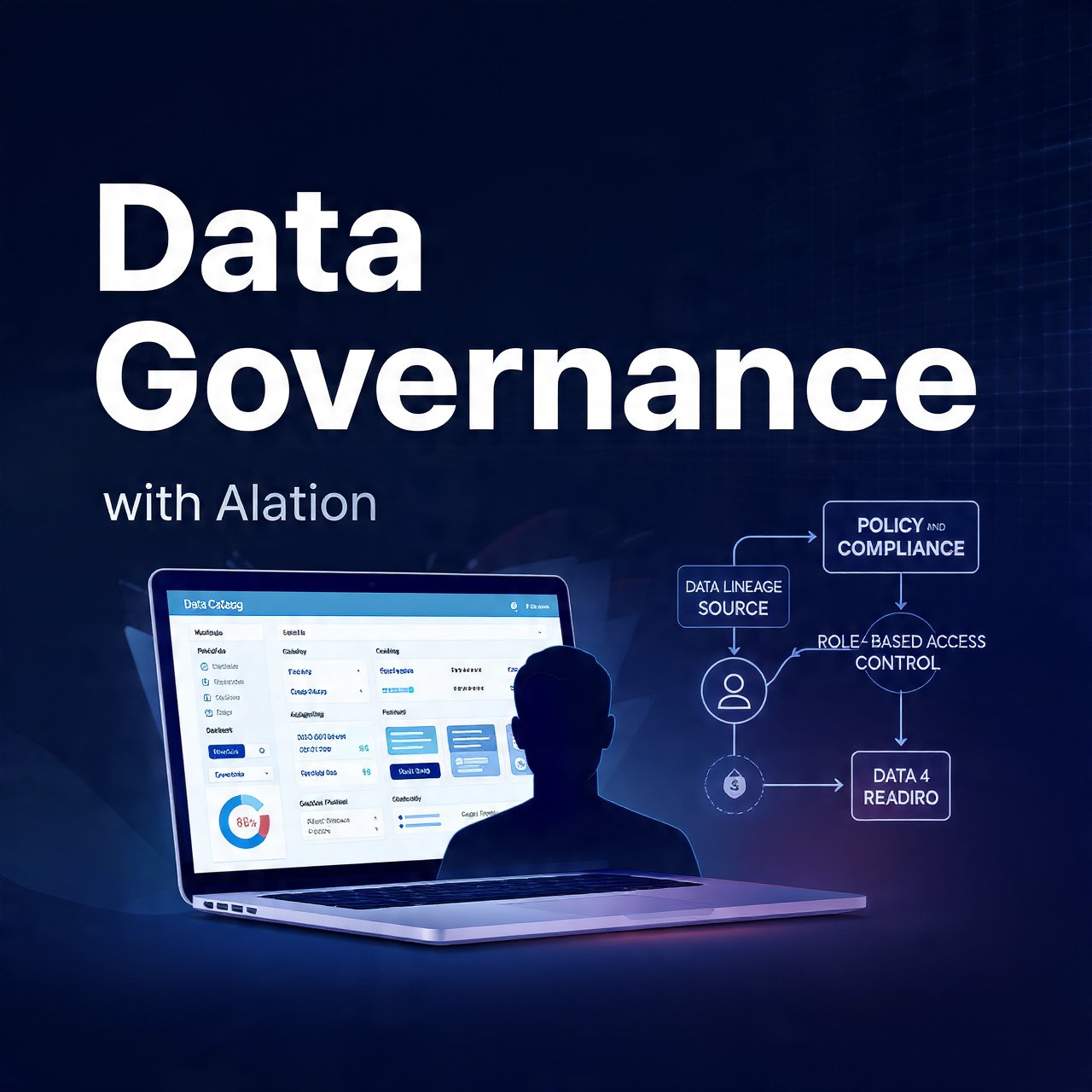
- Role focus: Data engineering with Alation centers on making data discoverable, trusted, and reusable across the enterprise. 2. Core capability: Alation’s data catalog provides fast, searchable metadata and a single pane to locate datasets, tables, reports, and BI assets. 3. Active metadata: It captures and continuously updates metadata from sources, enabling engineers to work with current schema, usage, and lineage. 4. Machine assistance: Machine-suggested annotations, automated tagging, and natural-language search speed discovery while leaving final validation to humans. 5. Data lineage: End-to-end lineage (column, table, report) helps engineers trace transformations, debug pipelines, and validate downstream impacts. 6. Integrations: Native connectors and APIs link Alation to data warehouses, lakes, BI tools, ETL platforms, and governance systems for seamless metadata flow. 7. Governance and stewardship: Built-in stewardship workflows, policy enforcement, and role-based access controls support compliance and operational ownership. 8. Collaboration: Collaborative features—comments, endorsements, and usage metrics—help engineers, analysts, and stewards converge on trusted assets. 9. Data marketplace: A governed marketplace lets teams publish curated, production-ready datasets with clear SLAs and documentation for self-service use. 10. Search and query intelligence: Natural-language and SQL-aware search surfaces relevant tables, sample queries, and common joins to accelerate pipeline development. 11. Security and compliance: Sensitive-data discovery, masking guidance, and audit trails help engineering teams meet regulatory and internal security requirements. 12. Automation for scale: Automated cataloging, scheduled scans, and policy automation reduce manual toil for teams managing large, evolving data estates. 13. Observability: Usage analytics and query logs provide signals for optimization, cost control, and identifying high-value datasets. 14. Advanced metadata use: Engineers can leverage behavioral metadata (who uses what, how often) to prioritize refactors, partitioning, and performance tuning. 15. Extensibility: SDKs and REST APIs enable embedding Alation metadata into CI/CD, dataops pipelines, and custom governance tooling. 16. Maturity path: For 3–7 years experience focus on discovery, lineage, and catalog-driven ETL; for 8–20 years emphasize governance strategy, automation, and metadata-driven architecture. 17. Impact: When adopted well, Alation shifts data engineering from firefighting to productized data delivery—faster onboarding, fewer incidents, and higher trust in production data.