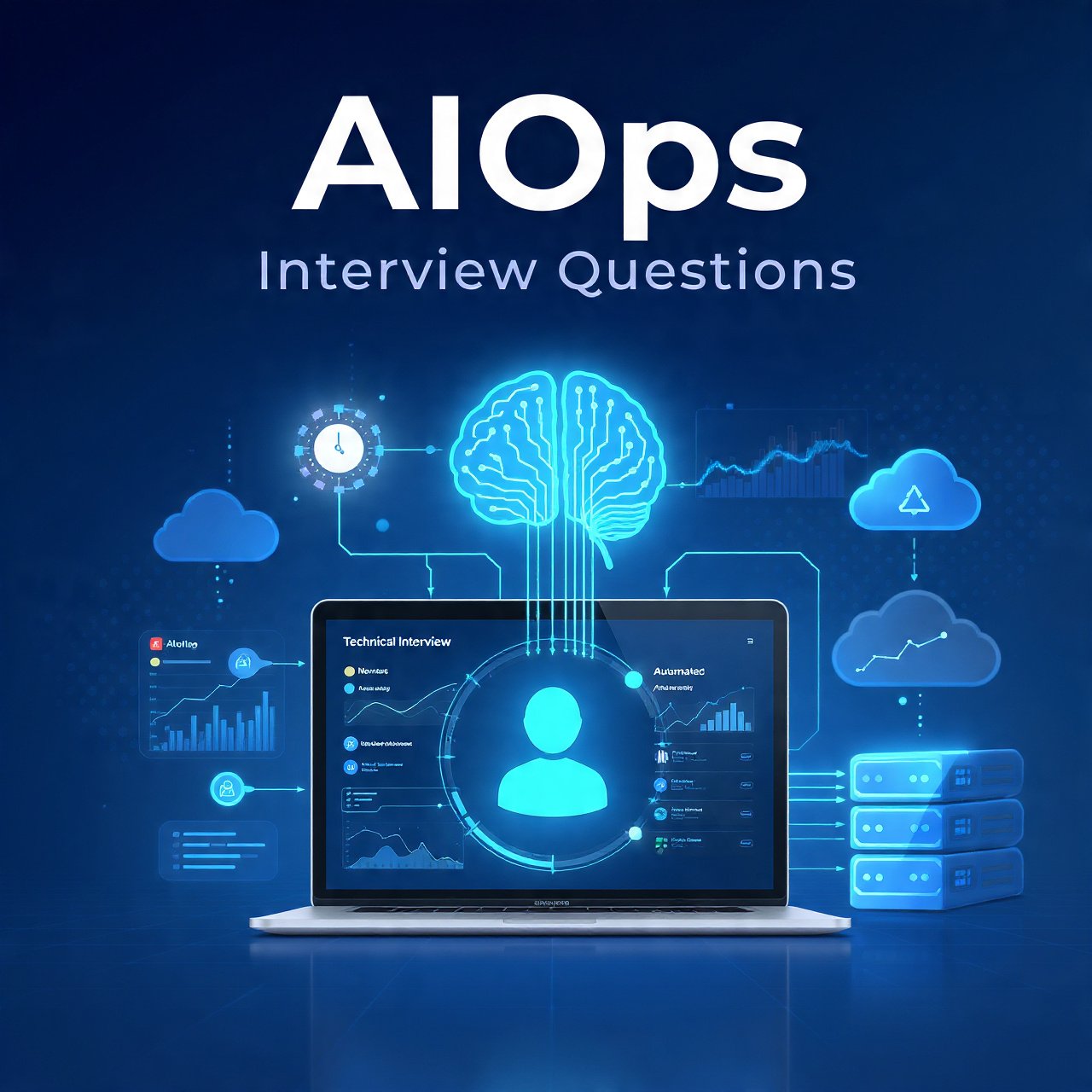
Description
- AIOps
- Definition: AIOps (Artificial Intelligence for IT Operations) uses machine learning, big-data analytics, and automation to ingest and analyze operational telemetry so IT teams can detect, diagnose, and resolve issues faster.
- Primary goal: The core objective is to reduce mean time to detect and repair (MTTD/MTTR) by turning noisy, high-volume monitoring data into prioritized, actionable insights.
- Data sources: AIOps platforms ingest diverse telemetry—metrics, logs, traces, events, topology, and configuration data—and normalize it for correlation and analysis.
- Noise reduction: AIOps applies event correlation and deduplication to collapse thousands of alerts into a small set of meaningful incidents, reducing alert fatigue.
- Anomaly detection: ML models detect statistical and behavioral anomalies across time-series and log streams to surface issues that rule-based monitors miss.
- Root-cause analysis: By correlating signals with topology and dependency maps, AIOps provides probable root causes rather than just symptoms, speeding diagnosis.
- Predictive insights: Advanced AIOps predicts capacity saturation, performance degradation, and failure likelihood so teams can act proactively.
- Automated remediation: Mature implementations support closed-loop automation—triggering runbooks, remediation scripts, or orchestration playbooks when confidence thresholds are met.
- Noise-to-signal prioritization: AIOps ranks incidents by business impact and confidence, enabling SREs and operators to focus on high-value work.
- Scalability: Designed for high-throughput environments, AIOps uses streaming ingestion, feature extraction, and online inference to analyze telemetry in near real time.
- Explainability and trust: Good AIOps surfaces explanations for model decisions (why an event was correlated or why an anomaly was flagged) to build operator trust.
- Integration patterns: AIOps integrates with observability stacks, ticketing systems, CMDBs, orchestration tools, and chatops to close the loop from detection to resolution.
- Operational metrics: Success is measured by reduced alert volume, faster MTTR, fewer escalations, and increased automation coverage.
- Security and governance: AIOps must enforce access controls, data retention policies, and audit trails because operational telemetry often contains sensitive information.
- Advanced capabilities: At scale, AIOps adds causal inference, multi-modal correlation (logs+traces+metrics), root-cause confidence scoring, and cross-domain incident stitching.
- Human-in-the-loop design: Effective AIOps combines automation with operator oversight, offering safe rollback, approval gates, and explainable suggestions rather than blind actions.
- Implementation risks: Common challenges include data quality and labeling, model drift, false positives, integration complexity, and organizational change management.
- Adoption path: Start with centralized telemetry collection and simple correlation rules, add anomaly detection and prioritized alerting, then iterate toward predictive analytics and automated remediation as confidence grows.